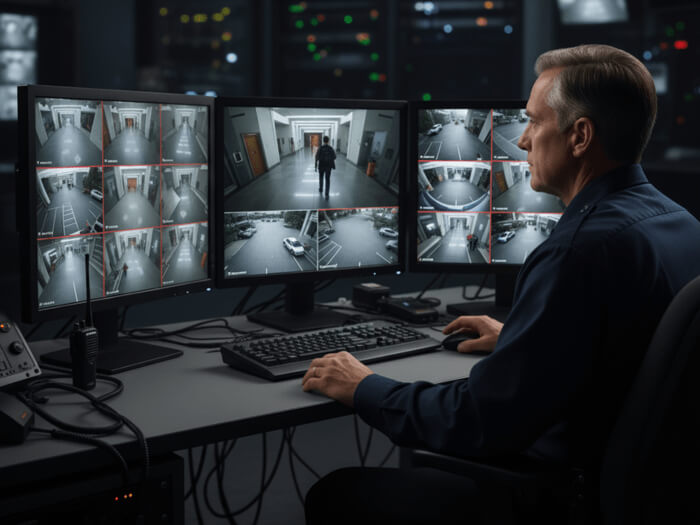
When you select a camera for video surveillance, an important aspect that you’re actually choosing is the camera’s lens. Just like typical cameras you use to take snapshots, surveillance cameras have a field of view (FoV). That simply means the size of the real-world scene they can capture at once. With a greater field of view, you can cover a wider stretch of a given area, while a narrower field of view allows you to show greater detail — but of a smaller area.
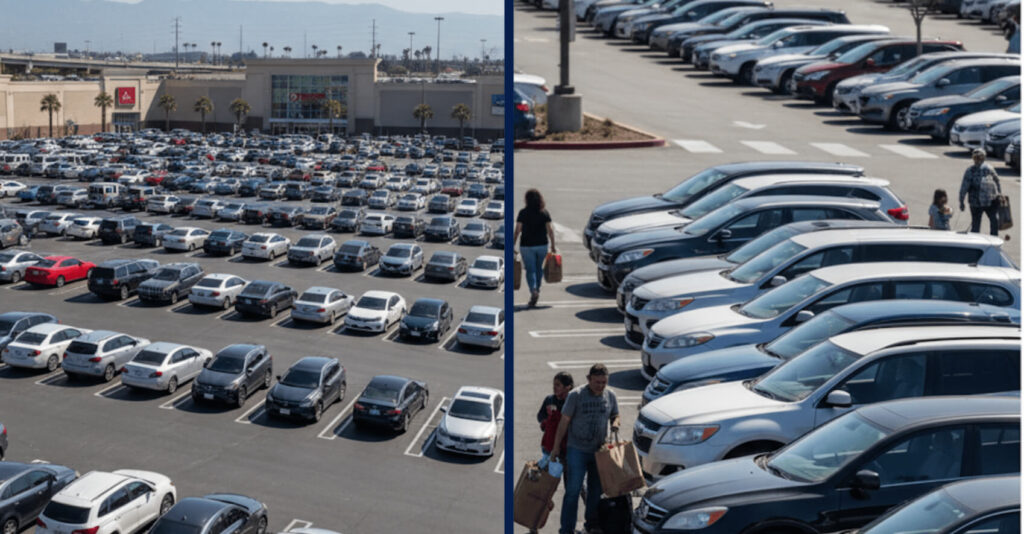
Every lens width comes with tradeoffs. The wider the field of view, the more distortion it will introduce, and the less of the camera’s sensors can be devoted to each person, vehicle, or object on screen. Basically, you can choose whether to get the biggest possible view of a scene, or the greatest possible detail of particular things within it. (So, the field of view is intimately linked to camera resolution, and it makes sense to consider them at the same time.)
How wide is your lens… right now?
A further complication: Some cameras feature varifocal lenses, which means they can physically zoom into or out of a scene. Others are built with a single, non-zooming lens, which means they have a constant field of view. These are commonly known as fixed lenses.
An object of the same size at the same distance will always take up the same amount of space (meaning, the same number of pixels) on a fixed-lens camera’s sensor. The image the camera creates can be cropped, but the original data from the camera will always show the same field of view. With a varifocal lens, the number of pixels devoted to a given object depends on how closely the lens has been zoomed in on it. A zoomed-in camera can capture details of a car, or read the writing on the side of a distant package — but at the expense of missing the objects that are outside its tightened field of view.
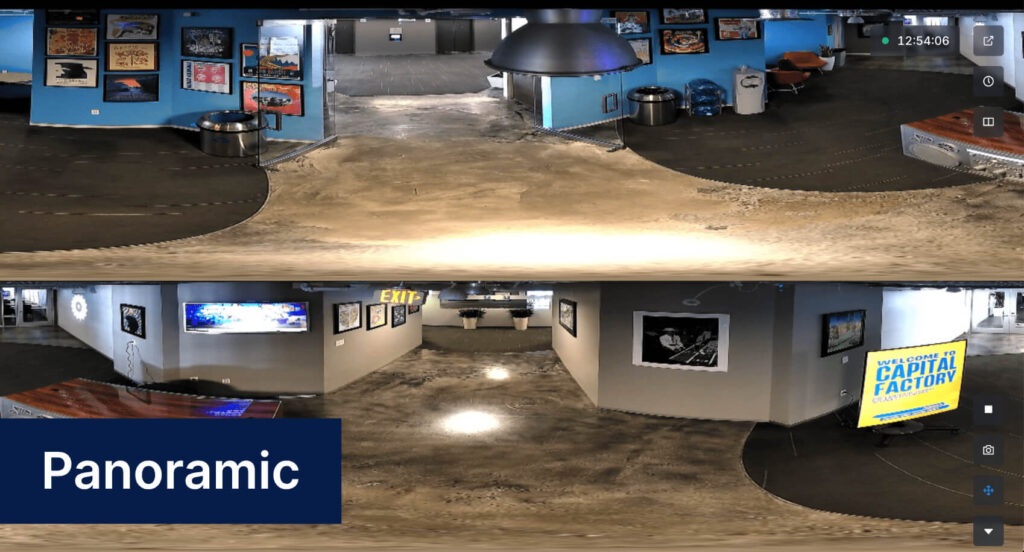
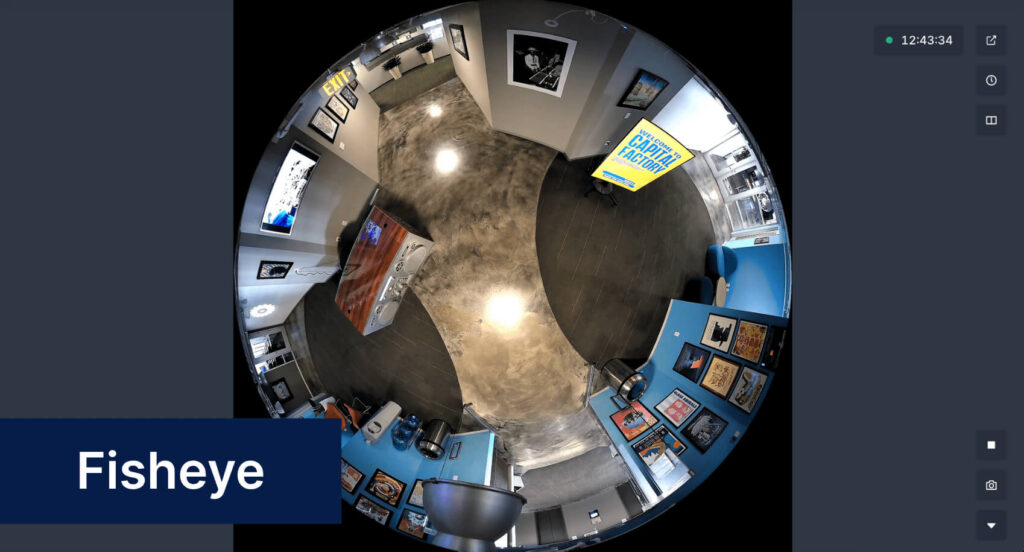
Distorting the data
If they can’t capture as much detail, why select a wide lens at all? Simplicity and economy are both good reasons. Wider-lensed cameras allow a far smaller number of cameras to cover a given area, and for many purposes, their lower resolution per object is completely acceptable. It also comes at a lower cost. Not only is each camera simpler, with fewer moving parts, but there are fewer cameras overall, less network bandwidth to account for, and fewer cables to route.
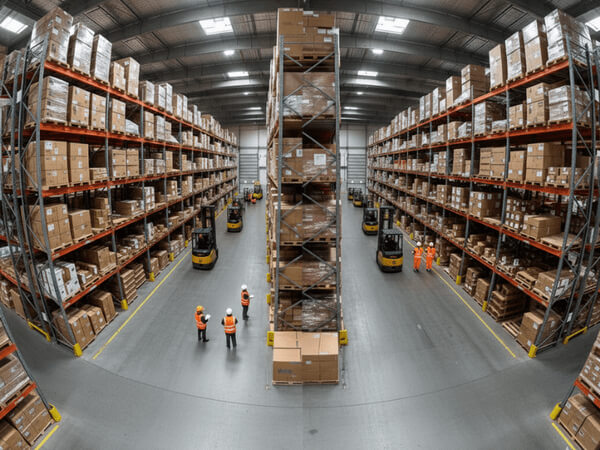
In detecting motion after hours in a warehouse or on a loading dock, a wider view allows a single viewer to see more of the scene at once without losing any important information. However, the actual image that the lens creates will exhibit some degree of warping, or distortion — very much like the convex side-view mirror in a car.
This effect is especially visible with extremely wide lenses, including the ones known as fisheye lenses. With ultra-wide-view cameras, even people, vehicles, or other common objects may be difficult to recognize, never mind interpret, and details such as text are nearly impossible for a person to read. Various points between these extremes offer different combinations of wide coverage, close-up details, and fidelity to the observed scene.
Fixed lenses have another advantage, too: They tend to be brighter (that is, they let in more light, for a clearer and more detailed image). In addition to typically being less bright overall, most varifocal lenses admit much less light when they are zoomed in at their greatest magnification.
That’s why for some purposes — like reading license plates or ID badges, or looking at a distant parking lot — fixed lenses and narrow viewing angles are called for, while in others, the advantages of seeing the whole picture at once, or a minimal camera count, outweigh the effect of camera distortion.
What about when excessive distortion just isn’t acceptable, but a wide field of view is called for?
One escape path: Multi-sensor cameras
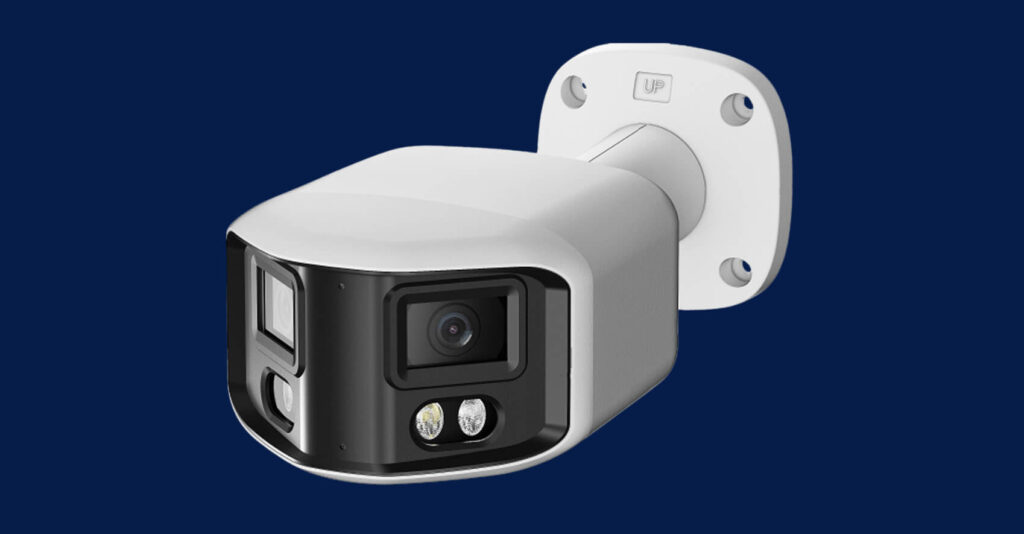
Multi-sensor cameras stitch together the output of two or more relatively narrow FoV cameras housed in a single chassis, creating a wide image with far less distortion than a single lens with a wide enough angle to span the same FoV. (Or, these cameras’ outputs could be transmitted separately, effectively putting multiple cameras in a single box but without combining their outputs into a single frame.)
Either way, multi-sensor cameras (like the Eagle Eye DX-01 and DX-02) simplify placement and mounting, compared to multiple cameras, because they cut the number of chassis needed.
Squaring the circle with dewarping technology
In some settings, whether because of tight physical constraints for mounting or a need to make a camera unobtrusive, the best choice of camera is one with an extremely wide angle. This could include a full 180° or even 360° viewing angle.
With these extreme wide-angle (fisheye) lenses, one part of the transmitted image may be clear but exaggerated, but the rest of the scene may look essentially like an abstract artwork, and be near useless to humans viewing it.
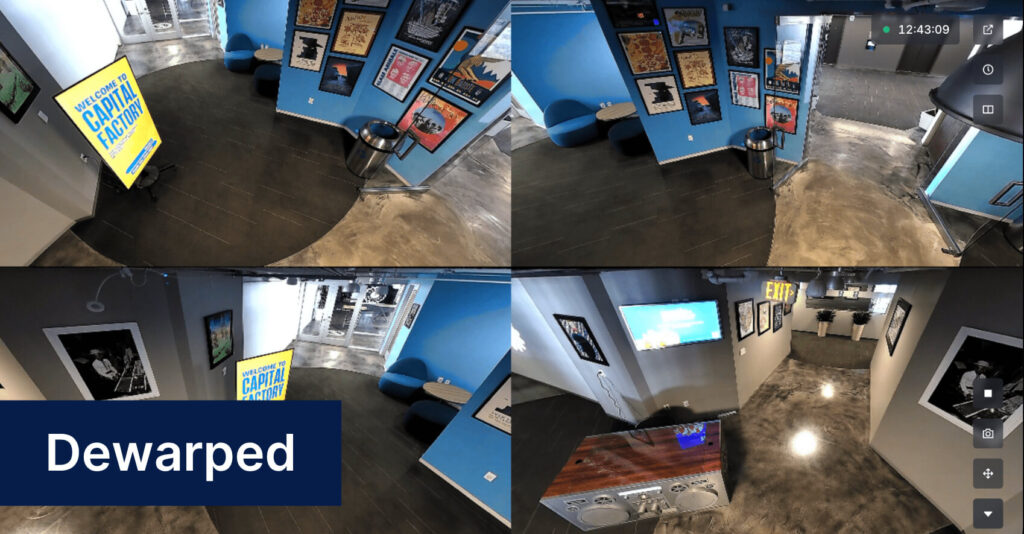
The approach to make this distorted image useful is to apply algorithms to digitally stretch or compress its elements — “dewarping” it— creating a rectangular image that shows the same scene in a much more natural viewing aspect. Even if some small degree of distortion remains, a viewer can readily make out the content of the image, as if it came from a much flatter lens.
This kind of image transformation is much easier to describe than to perform. Especially for video, it’s a computationally intensive process, because each frame needs to be transformed. Accordingly, video is often left in its original, distorted form unless a particular segment is called for. However, fast dewarping has become far more practical, thanks to both cloud computing (which allows processing on powerful computers upstream of the camera) and the increasing capabilities built into cameras themselves.
With high-resolution sensors and a sharp monofocal lens, even fisheye lenses can yield excellent results.
Want to know more about how camera choice affects your surveillance options?

Timothy Lord has witnessed and written about IT security trends and the ongoing evolution of SaaS for more than 25 years.
あなたに興味があるかもしれない他の投稿

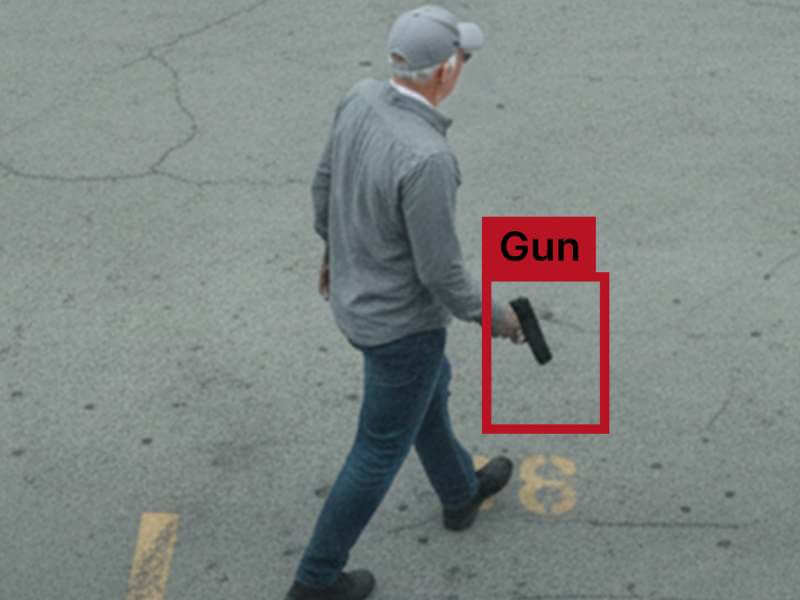
Are there guns in the picture? How video surveillance helps
There have been many cases in …
10月 15, 2025